- The Intersection
- Posts
- 5 Books from 2025 to help you build, create and lead
5 Books from 2025 to help you build, create and lead

Daniel Francavilla
December 19, 2025
Whether it’s your last official day of work for the year today, or you’re scheduled sporadically (corporate office schedules are wacky), or you simply don’t take a break, it’s that time of year for roundups and recaps.
This one’s about books. Throughout 2025, there were a few that stood out to me for one reason or another.
As we wrap up the year, I’ve selected 5 books that were released in 2025 that sit at the intersection of identity, time, business, careers, and creativity…
For this edition of The Intersection, I’m introducing you to each of them (which I bought in print, but some also in audiobook — do you do that too?).
Read on to see what they’re about, what stuck with me, and the common threads that connect them — especially for leaders, creatives, founders, nonprofit teams, and anyone building their work in public.

The Purpose of Purpose
Making Growth the Heart of Your Business
By Ron Tite | Buy the Book
First, we have to start with the concept that mission-driven “doing good” is table stakes now. If your organization wants to thrive in a world where people expect decency, you don’t get a gold star for saying you care. The real question is, what is purpose actually doing for your business?
Ron reframes purpose as a growth engine and applies his Think/Do/Say approach to making purpose real, measurable, and operational.
Why I picked it up
I’ve followed Ron since my early agency days, back when he was running The Tite Group, before it became Church+State. I’ve always liked how he cuts through jargon, isn’t afraid to call out silly examples, and makes business feel human. This book resonates because it challenges “purpose as performance” without letting leaders off the hook.
Takeaways
Purpose isn’t a sentence, it’s a system. If it doesn’t shape decisions, it’s decoration.
If you want trust, you need coherence. What you say has to match what you do, consistently.
Growth isn’t a dirty word. In a caring world, growth can mean more impact, better talent retention, stronger partnerships, and more resilience, if you define it well.

Time Anxiety
The Illusion of Urgency and a Better Way to Live
By Chris Guillebeau | Buy the Book
This book gives a name to something a lot of us feel but rarely articulate: the stress that comes from believing we’re behind, late, or running out of time, whether or not that’s true. Chris frames time anxiety as less about “not enough hours” and more about unrealistic expectations and misaligned priorities. He offers practical ways to rework your relationship with urgency (and with your own internal time rules).
Chris pushes readers to build tolerance for incomplete to-do lists, stop chasing “catching up,” and make peace with trade-offs — because life is just values competing for calendar space.
Why I picked it up
Chris’s work has been on my radar for a very long time. I read his book The Art of Non-Conformity way back when I was a student running a nonprofit and in the early days of freelancing, and it genuinely shaped how I think about work and self-direction. This new one resonated enough that I wrote about it in my newsletter in August.
Takeaways
Optimization isn’t alignment. You can get more efficient at the wrong things.
Watch for phantom deadlines. The deadlines you inherited from culture, peers, social media etc. are not from your actual values.
Rewrite your “time rules.” The invisible standards like “I reply immediately” or “I must always be available.” Chris argues that these rules silently run your life unless you replace them.
Trade-offs are the point. You can’t do everything. But you can choose what you’re doing on purpose.

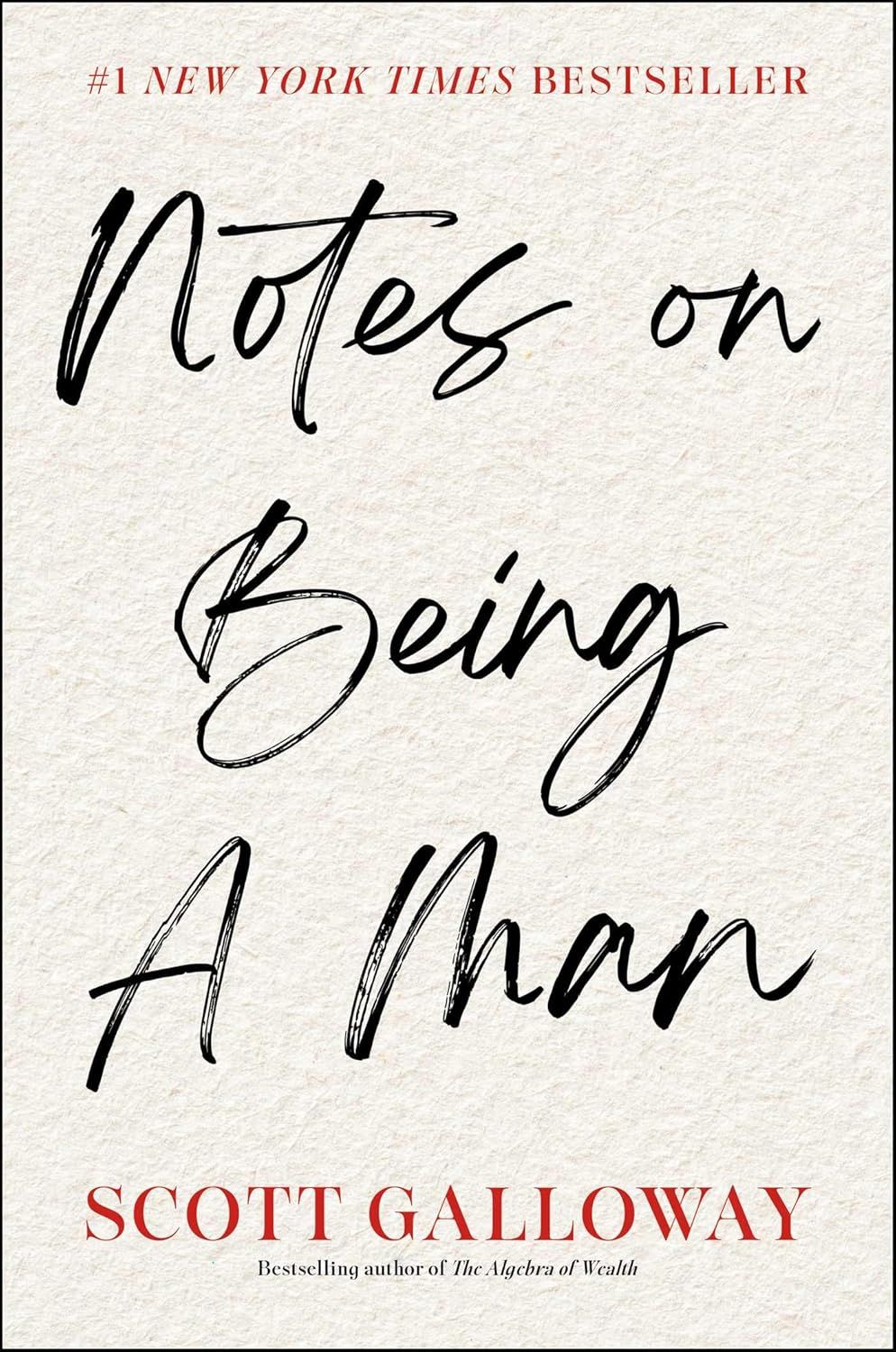
Notes on Being a Man
By Scott Galloway | Buy the Book
For this book, NYU prof, entrepreneur, and co-host of Pivot, Scott Galloway, shifted from his usual lane of business, markets, and tech into something more personal, and a bit loaded: What it means to be a man today, and what it means to raise boys well. This one blends a lot of data (education gaps, loneliness, deaths of despair), memoir (his upbringing, anger, depression, fatherhood), and practical lessons aimed at helping men build healthier lives and relationships.
It’s also generating debate. Some critics argue that Galloway’s framing leans into traditional roles and a “crisis” narrative that can flatten more complex social realities.
Why I picked it up
I’ve been an avid listener to Scott’s podcasts for years and have his other books. I was at his Pivot Tour live recording in Toronto last month. This is his latest book, and I bought it by default since I get so much value from all of his other content (for free) all year.
Takeaways
Loneliness is a systems problem, not just a personal one. If your community, workplace, or org doesn’t create “third places” and belonging, people will find substitutes (often unhealthy ones).
Action over anxiety. A recurring theme is movement — doing something as a way to metabolize anxiety. (Scott often also says to build surplus value and face challenges head-on).
Be useful. Be kind. Build relationships. It sounds obvious, but it’s not the default for all. If you’re building a brand, a team, or a life: relationships are still essential.
Take responsibility (protect, provide), cultivate authenticity (embrace vulnerability, get offline, find purpose), and foster connection (kindness, community, good relationships, being good to mothers/partners).
The Uncertainty Advantage
Launching Your Career in an Era of Rapid Change
By Scott Stirrett | Buy the Book
This one is a career guide for a world where the old playbook is obsolete. Scott Stirrett positions uncertainty like AI disruption, unpredictable job paths, and economic volatility not as something to fear, but as something you can learn to leverage.
The book emphasizes decision-making without overthinking, unconventional approaches to standing out, resilience/“antifragility,” and doubling down on human skills AI can’t replace, like storytelling, judgment, and influence.
Why I picked it up
While I’m not just “launching” my career now, this year I spoke in a Venture for Canada program (the organization Scott founded and just left after 10 years), and hired students through their Intrapreneurship Program. I’ve had a front-row seat to the reality young people are walking into, and this book is a timely bridge between what’s happening and what to do next.
Takeaways
Stop waiting for clarity. Clarity usually shows up after motion.
Human skills are the moat. Storytelling, influence, and judgment aren’t soft but strategic.
Non-linear is normal now. Treat your path like a portfolio, not a ladder.

Brave Creative Human
Embrace Creativity, Reframe Imposter Syndrome, and Be Unapologetically You
By Diana Varma | Buy the Book
This is a book for people who want to create and are tired of fear being their creative director. Diana Varma’s focus is creative confidence: embracing failure, reframing imposter syndrome, and choosing to make work anyway — even when you feel unqualified, behind, or exposed. She also shares the human reality of making a book (iterations, edits, sourcing, uncertainty, and choosing self-publishing to keep momentum and creative control).
Why I picked it up
I met Diana at DesignThinkers this year and bought the book after she spoke — probably my favourite way to discover books. The concept and design stood out to me, and I also thought aspiring creatives like my students could benefit from it.
Takeaways
Failure isn’t the opposite of talent, it’s the tuition.
You don’t overcome imposter syndrome by waiting. You build evidence through reps.
Iteration is the job. The “messy middle” isn’t a detour — it’s the process.

What’s common across all these books?
After thinking more while writing this, these books all say versions of the same thing. Here are a few of the common themes, and why they matter now:
Build your life and your work on alignment, not approval
Time anxiety, purpose theatre, career ladders, imposter syndrome… all of them thrive when we outsource our definition of success.
Action is a strategy (not just a personality trait)
Whether it’s anxiety, uncertainty, or creativity, movement creates information. Information creates confidence. Confidence creates momentum.
The “human stuff” is becoming the competitive advantage
Relationships. Kindness. Storytelling. Judgment. Influence. Community.
These are differentiators, not just extras, in our AI-saturated world.
Purpose has to show up in decisions, or it’s just vibes
This is true for brands, nonprofits, careers, and personal lives. If it doesn’t shape behaviour, it’s not purpose (maybe just convincing branding instead).
5 Things to Take into 2026
If you take just a few things from this pre-holiday week edition of The Intersection, here are some key takeaways and things to think about (especially for founders, nonprofit leaders, and creative humans).
Rewrite your time rules. Where are you performing urgency instead of protecting what matters?
Name your phantom deadlines. What timeline are you chasing that you didn’t consciously choose?
Operationalize purpose. What decisions does your purpose actually change this quarter?
Invest in human skills. Are you training your team (and yourself) in storytelling, judgment, and influence, not just tools?
Create before you feel ready. This is one I often share. If you’re waiting for confidence, that’s something only putting in the reps can produce.
Now what?
If you’ve read any of these, I’d love to know your takeaways. And if you didn’t, what’s one thing you read in 2025 that changed how you think, lead, or create?
During the holiday “break”, I’ll be making some progress on the book for young people that I’m co-authoring with Daniel Lewis. Hold us accountable 🙂
Thanks for reading!
