- The Intersection
- Posts
- Frozen Values: When brand trust dips
Frozen Values: When brand trust dips
Hootsuite and the cost of values drift and brand misalignment

Daniel Francavilla
February 06, 2026
Brand trust used to feel like a “soft” thing — nice to have, hard to measure, easy to postpone until after the next quarter (and I’ve worked on those RFPs and proposals). But that era is over.
Trust isn’t built by a campaign, it’s built by consistency — the slow, boring alignment between what you say, what you do, and what you’re willing to walk away from.
A very public brand alignment issue came into mainstream media a few weeks ago.
Canadian tech company Hootsuite has been facing backlash for work connected to U.S. Immigration and Customs Enforcement (ICE). The social media management and support contract is worth up to USD $2.8M (BetaKit has more).
But it’s the second time Hootsuite has come under fire for working with the U.S. agency. In 2020, the company’s then-CEO had to cancel a contract with ICE after strong employee and public backlash. Years later, however, the company hasn’t cut ties with ICE.
Who cares? Besides the media attention, hundreds of people showed up outside the company’s HQ to protest and call for the contract to end (as reported by The Washington Post). There’s even an online petition about it.
From a brand strategist’s lens, this isn’t primarily a debate about geopolitics — it’s a case study in something more basic (and brutal):
Values either show up in decisions, or they’re just decoration.
What made this a brand problem, beyond a PR moment
For one, it’s not the first time. Hootsuite backed away from an ICE-related deal less than 6 years ago after internal and external pressure. The “lesson” people took was: employee voice matters, community pressure works, values won. (More on that soon).
Fast forward to new leadership, new context, and new decisions.
Suddenly, the “values story” people were sold feels conditional.
That’s why this is landing as somewhat of a betrayal, not just a misunderstanding.
When a brand’s own language about “who we are” is loud, and the decision feels like a contradiction, the public doesn’t experience it as complexity.
They experience it as inconsistency.
And inconsistency is the downfall of trust.
Brand trust is the permission slip for everything else: attention, retention, referrals, recruiting, partnerships, and the benefit of the doubt when you inevitably mess something up. What about Hootsuite?
(Also, if your product is literally about helping brands navigate public sentiment, you wouldn’t act surprised when the public has feelings).

Canadian values and the expectations gap
When people bring up “Canadian values” in moments like this, they’re pointing at a collection of expectations:
fairness and dignity in how people are treated
inclusion as a baseline, not a campaign
privacy and caution around surveillance-adjacent tools
being a “good neighbour”, especially when power imbalances are involved
The brand tension here is that the company has publicly positioned itself around inclusion and community impact — “Inclusion is the heart of what we do,” for example, appears directly in Hootsuite’s own messaging.
So when stakeholders believe the contract crosses an ethical line, it creates a gap:
What the company says it stands for vs. what people believe it is enabling.
That gap is where support falls.

What fellow marketers are saying
In their newsletter, The Grow Op, the Growclass team framed it clearly: When values become “inconvenient,” were they ever values, or were they theatre?
“Values should mean something.
They shouldn’t just be a tool to control employees.”
Either way, there’s a brand risk.
Because in 2026, stakeholders don’t only judge what you do.
They judge whether you meant what you said.
And when people conclude you didn’t, the damage isn’t limited to one contract — it spreads to every claim you make after that.
On brand and employee value alignment
As I mentioned, Hootsuite’s website says it values inclusion and commits to “give back to our communities and be an ally.”
“It becomes an important part of their brand image, which becomes an important part of their strategies to attract not only consumers and investors, but also employees. So when something like this happens, employees may have some real problems with it and may feel really compromised.”
The decision marks a shift in how much the company values social responsibility, Bakan said.
The company apparently terminated employees previously for speaking out about other contracts with the Department of Homeland Security and ICE, however.
What can employees do?
For those who work at companies that may act out of alignment, as Hootsuite has done, Growclass CEO Sarah Stockdale shared a few things to consider:
“Senior leaders have power…and a duty to use it. They should speak publicly, organize internally, and help more junior employees line up work before exiting or speaking out.
Remember that staying doesn’t mean endorsing. Let’s be honest, it’s not always as easy as just quitting your job during a brutal job market. Moral clarity doesn’t pay the bills. Needing to survive does not make you complicit in what your employer is doing.”
5 brand misses beyond the headlines
1. Hootsuite treated values like copy, not governance
Values aren’t a page on your website — I’ve said this before in talks and with clients for years. They’re a filter for decisions, especially the uncomfortable ones. If you don’t have an internal mechanism for “we don’t do business with X,” then your values are just words.
2. They underestimated stakeholder overlap
In a SaaS business specifically, the lines can blur… customers are employees are community members are future hires are partners. A decision that angers one group rarely stays contained, as it can ripple into renewals, referrals, hiring pipelines, and reputation.
3. They misread the “this is business” defence
In statements reported by multiple outlets, the company’s leadership position is essentially: we work with many organizations; providing tools isn’t endorsing actions. Brand-wise, that argument often fails because stakeholders aren’t debating intent — they’re debating impact.
4. They stepped on a sore spot, twice
The second time is always worse, because it signals learning didn’t stick. Even people who don’t follow politics closely understand the simple narrative of “You said you wouldn’t, but now you did.”
5. They let the story get written for them
The existence of internal fear (people not feeling safe speaking up) has been raised in reporting tied to internal materials (as covered in Canadian HR Reporter). Whether or not every detail is fully verifiable publicly, once that perception is out there, the reputational cost is real: culture credibility collapses.
Losing support, and why it matters
This is where brand strategy impacts the bottom line:
Employee trust — and the willingness to stay, refer, recruit, and defend the company publicly
Customer confidence — especially for purpose-led brands, public sector adjacent orgs, and companies with strict procurement ethics
Partner ecosystem — agencies, platforms, and communities that don’t want reputational splash damage
Category credibility — being a “trusted” social tool while becoming a symbol in a trust controversy is obviously not ideal
Local goodwill — protests outside your HQ are a loud signal that your social license is shrinking
What’s the cost of all this?
If they consider the contract to be financially significant, the brand cost can easily outpace it over time — through churn, hiring friction, lost deals, and a permanently higher “trust tax” on every sales conversation.
What it could take to repair this
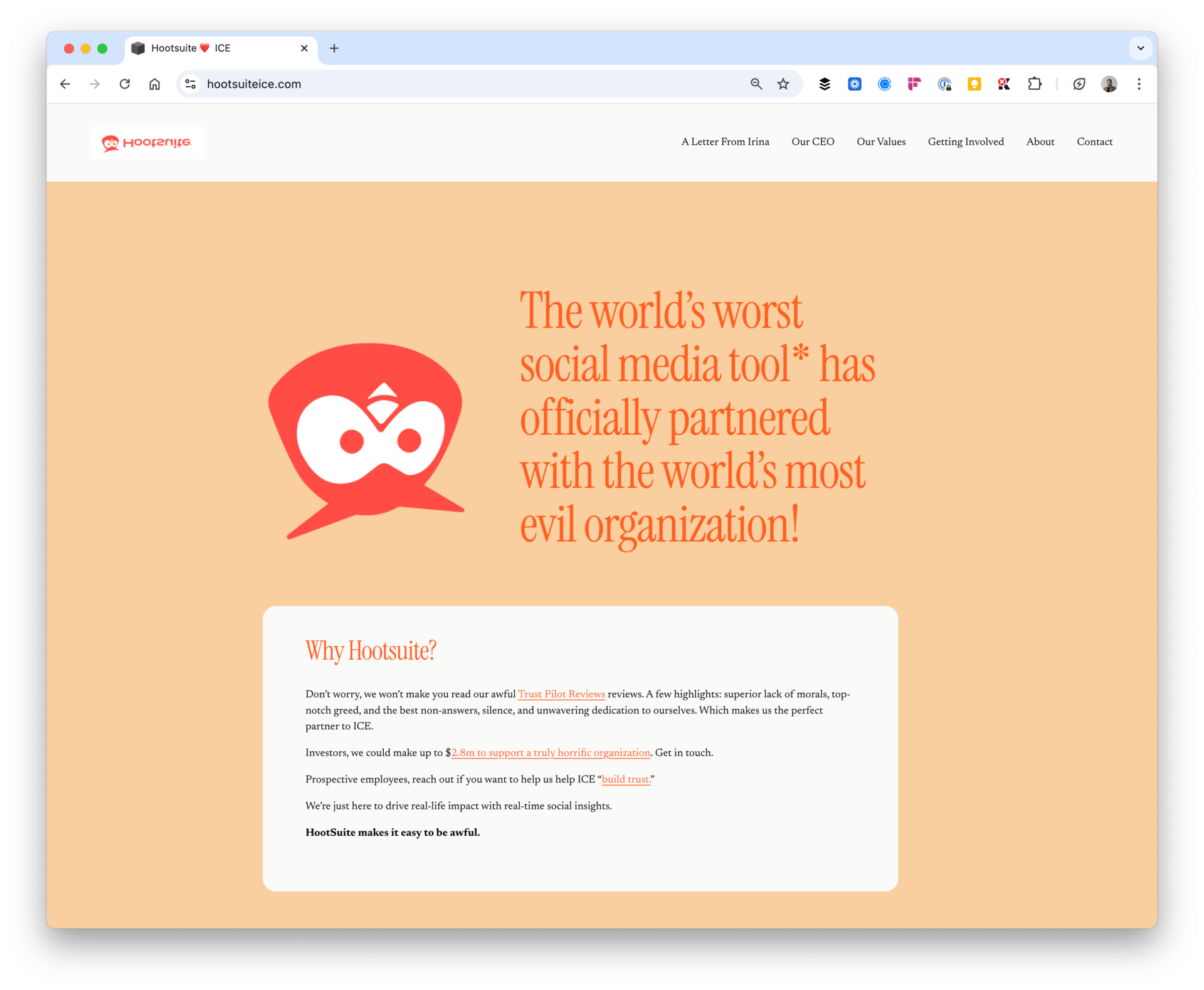
A statement or a “we hear you” won’t cut it, and given the backlash at this stage, I’m not sure. There’s even a satirical site called hootsuiteice.com:
A real repair plan could look something like:
Clear boundaries statement — a public policy for government and enforcement-related work (what’s in, what’s out, who decides)
A transparency report — disclose categories of government partnerships and how they’re evaluated
An independent review — third-party assessment of what the contract does and doesn’t enable (and publish the summary)
Internal protections — stronger channels for employee concerns, with explicit anti-retaliation commitments
Values re-commitment with proof — not new words; measurable actions that show values are operational
Sure, this all sounds costly. But values are really real when they have a price tag.
UPDATE
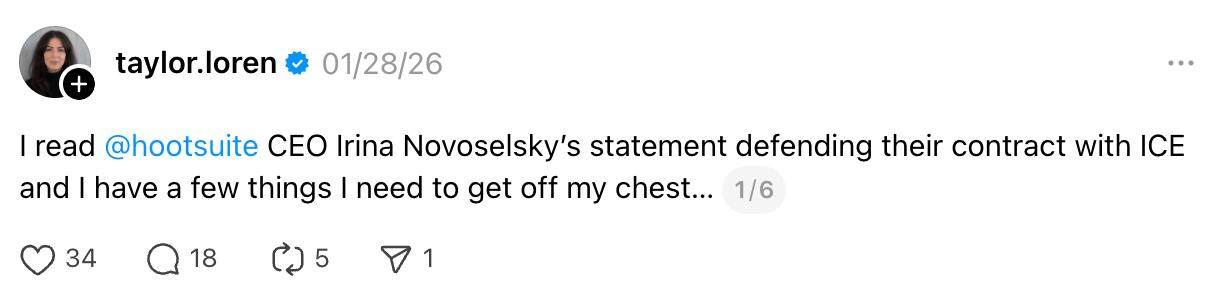
Hootsuite’s CEO Irina Novoselsky shared in this statement that "what we are watching unfold right now is wrong." She said the loss of life and the fear being felt in communities as a result of recent enforcement actions are "devastating."
"Beyond how painful it has been to process the current situation on a personal level, we have also felt the concern expressed about Hootsuite’s work with ICE’s public affairs office.”
Her statement doesn’t commit to an end to the contract, though, saying the company's responsibility is to its customers and standards that demonstrate how its technology is used.
On social media platforms, from what I saw, her statement may have made things worse.
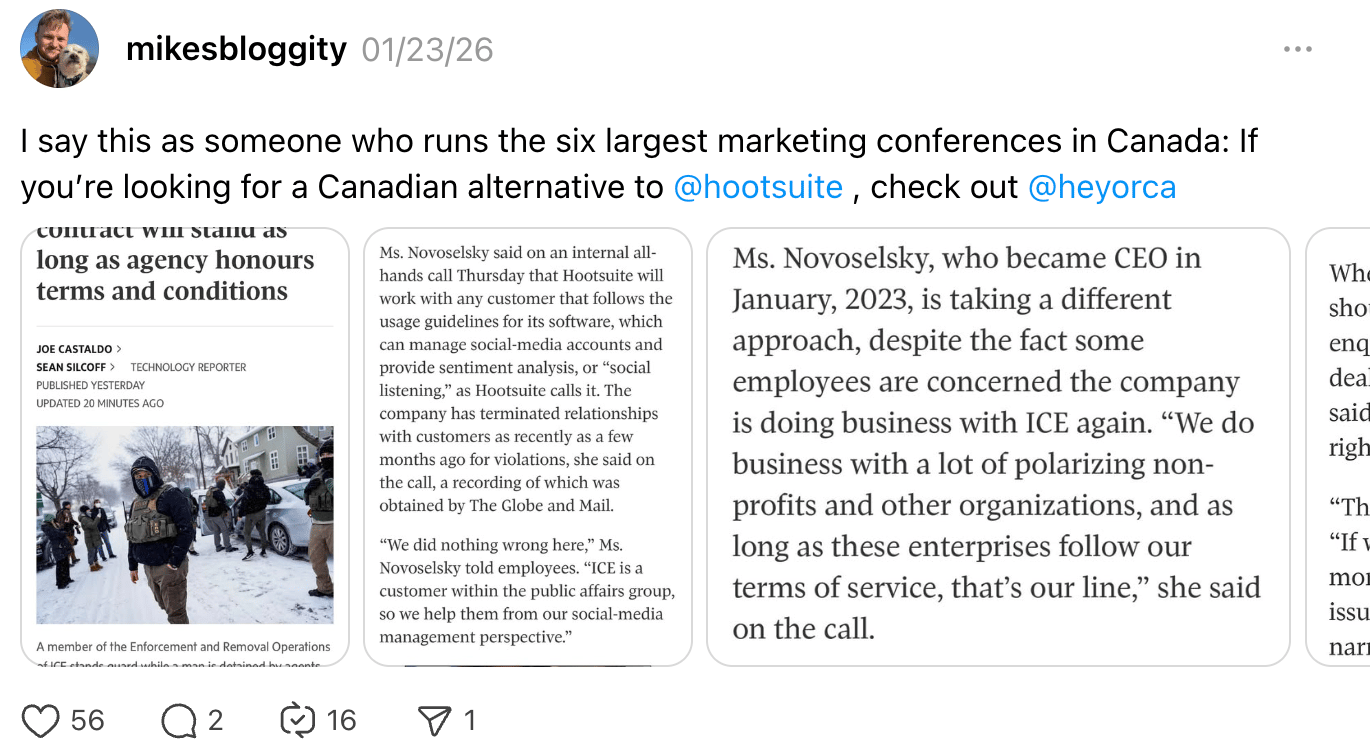
And if you’re in the market for a Canadian alternative, there’s HeyOrca (as Mike suggested below on Threads). I spoke at their Community Summit last year, along with a webinar, and they’re an awesome team.
What do you think?
Do these issues matter to you as a user of a tech tool?
When a company says “we’re inclusive” and “we’re neighbours and allies”, what should that actually restrict them from doing?
What would make you feel like values are real without requiring you to become a whistleblower?
Let me know your thoughts.
I know it’s not a light topic, and it’s a tough time for many.
COMING UP
See you online and on-stage
Later this month, I’ll be speaking at Dx3 in Toronto on a panel where we'll look at the convergence of commerce and content, the rise of livestream shopping, and how brands can thrive in the “everywhere store” era. Brands have faced headwinds this year already, ranging from economic uncertainty and evolving consumer behaviour to rapid digital transformation and supply chain disruption. Backed by a bold new format, the DX3 conference is back with valuable content, networking, and partnerships. The industry is coming together in Toronto on February 24 to solve problems, spark innovation, and shape what’s next.

Next month, Growclass is hosting a live online event on March 12 called Brand Camp – a virtual summit for marketers who are building brands with depth — looking at what it really takes to build a brand that connects, converts, and stands the test of trends.

Thanks as always for reading The Intersection! I appreciate you.
