- The Intersection
- Posts
- Unexpected lessons from a week of slopes, skis, startups and stories
Unexpected lessons from a week of slopes, skis, startups and stories
Techskis and the power of being in the room

Daniel Francavilla
March 06, 2026
Where else do you meet Olympians, award-winning journalists, serial startup founders, authors, venture capitalists, community builders and health practitioners in one place?
At a ski club in The Blue Mountains, it turns out.
This week I was fortunate enough to spend time out there for Techskis — gathering of founders, investors, and operators that blends entrepreneurship with sport, community, and real conversations.
Yes, there was skiing and cold plunges, but not for me.
About 200 people came together for the second year of this unique gathering (clearly not for a typical conference filled with polished decks and surface-level networking). Instead, founders were talking openly about pressure, identity, resilience, and what it actually takes to build something meaningful.
One of the things I’ve learned from years of events is that the most interesting insights often happen between the talks, not just on the stage.
I spent a good portion of time capturing conversations and stories from founders, which I’ll be sharing soon.

A sneak peek at just some of the conversations I had on-camera on the sunny, snow slopes. Shot by Javon.
There was lots going on outside, but the stage at Techskis truly was full of insights, too.
Sometimes it’s just about putting yourself in the right rooms, and this was definitely one of them.
Here are a few reflections and takeaways that I thought were worth sharing — let me know if anything sticks with you!
Authenticity is not a tactic.
There was no better way to get the energy up at 9 AM than with Jake Karls, co-founder of Mid-Day Squares.
If you’ve ever seen Jake online, you know he shows up exactly as he is. Loud, energetic, raw, fun, human.
Jake spoke about authenticity, identity, and the mental load of building in public. A topic that resonates deeply with the work I do with founders through content and storytelling. His core message was simple but powerful:
People connect with real.
Mid-Day Squares turned this philosophy into a competitive advantage. Instead of hiding the chaos of entrepreneurship, they document it. The highs, the anxiety, the setbacks, and of course the wins (that we all feel part of).
He shared that AI can generate endless polished content, but human honesty is becoming more valuable.
For founders thinking about content, the takeaway is to tell the real story. Because storytelling isn’t just marketing, it’s leadership. Your story becomes your strategy.
I asked Jake how leaders and founders can start prioritizing storytelling. It starts with baby-steps, he shared, and everything compounds. Love that he said that, because “Content that compounds” is what I’ve been saying with Clarity Content.
Jake’s advice is that the story you tell yourself is the most important story. (Whether you’re selling software or B2B services, it’s all about sharing that story and building trust).

Community isn’t soft. It’s a performance multiplier.
One of the sessions you could see me nodding along with was called Community is a Performance Multiplier.
The panel included collaborators like Eric Rafat of FoundersBeta and Megan Rafuse of Shift Collab, alongside Brad Duench and Hana James (Greenhouse Juice, who gave out great protein smoothies).
We often treat community as a feel-good concept.
In reality, as these founders shared, it can be performance infrastructure. Those who operate inside the right circles tend to:
Make faster decisions
Recover quicker from setbacks
Take smarter risks
Stay in the game longer
Outperform equally talented peers
The best athletes don’t just train harder, they train in the right environment. They surround themselves with people who raise the standard.
Founders are no different. Entrepreneurship can be isolating (many of the founders shared this in my interviews with them). You’re constantly navigating uncertainty, expectations, and pressure.
But the right community changes the equation, as it makes you better (not because it makes things easier).
AI is reshaping the world, and the stories we tell about it
On the slopes, I spoke with Andy Mills, a journalist and co-creator of The Daily at The New York Times. We ended up going deep on something I found interesting:
How information moves across formats. Journalism, media, podcasts, newsletters, social video content. Each format shapes the story differently. And the audience has different expectations for what they’re consuming, too.
Many of the most important technology debates are unfolding through new storytelling mediums.
His talk focused on the race to build Artificial General Intelligence, based on his series The Last Invention.

Andy’s perspective was thoughtful and balanced. He explored the competing narratives shaping the AI conversation — from accelerationists to skeptics to those advocating for responsible development.
I appreciate his commitment to curiosity and listening. When everything feels polarized, the ability to explore complex ideas with nuance is becoming incredibly valuable — especially in technology, in media, and for founders trying to understand where the world is going.

Andy extended his interview in an impromptu convo with Megan — Javon and I were there to capture what they uncovered.
Longevity in your career or business is a skill
One of the more unexpected talks came from Brad May, a former Toronto Maple Leafs player and Stanley Cup champion.
Not your typical tech conference speaker. But his talk focused on high performance, identity, pressure, and purpose.
Brad played over 1,000 NHL games, which is rare. He understood something founders often overlook: Longevity is a skill.
Building something meaningful isn’t just about peak moments. It’s about staying power. The ability to keep showing up when pressure is constant, and the scoreboard doesn’t always look good.
Some themes from the session that translate directly to entrepreneurship:
Separate your identity from short-term outcomes
Adapt without losing your core values
Find purpose beyond external validation
Build habits that allow you to stay in the game
Athletes and founders operate in surprisingly similar environments. Constant evaluation, high expectations, limited margin for error.
The difference between people who last and those who burn out often comes down to mindset and self-awareness.
The reality of entrepreneurship right now
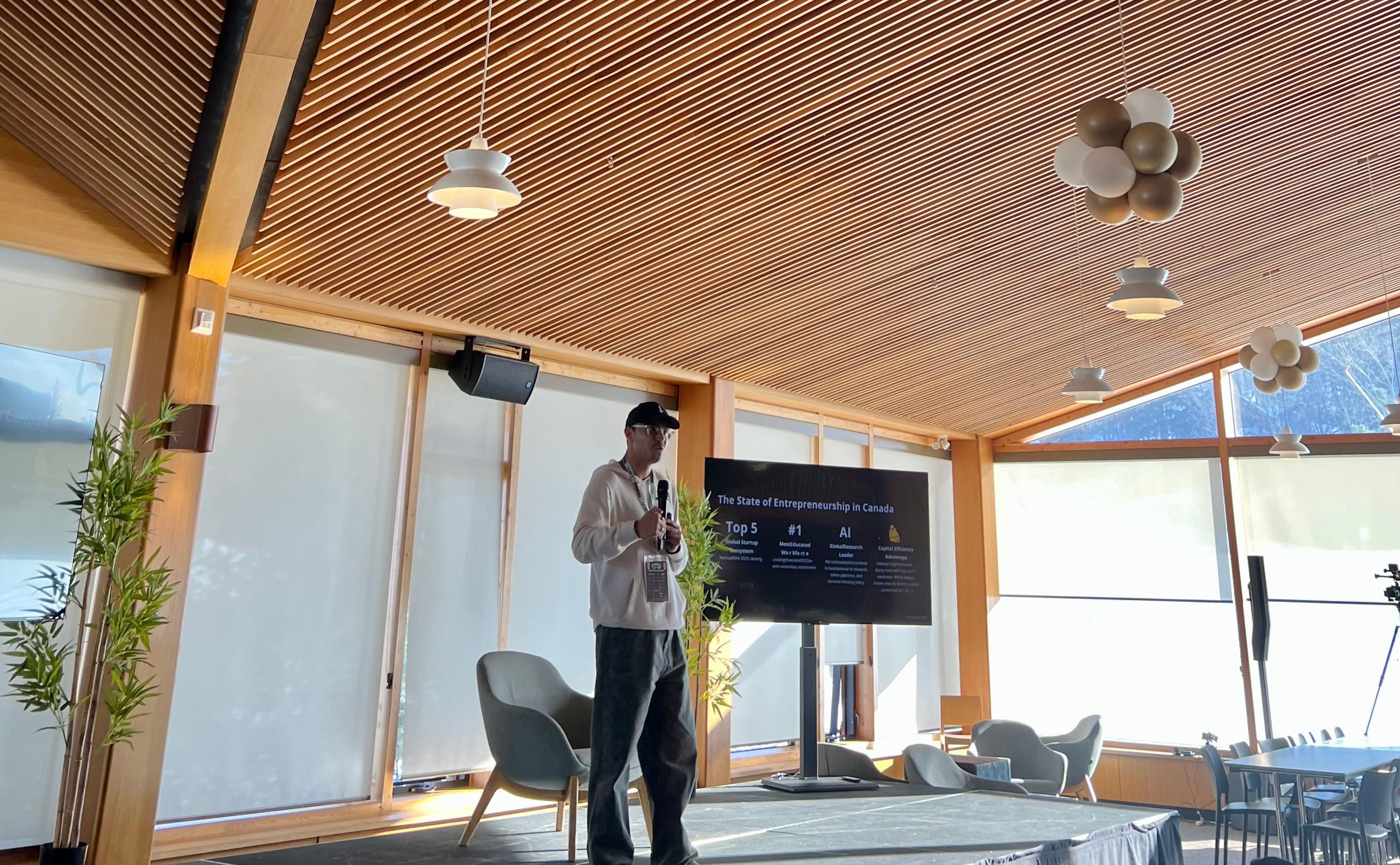
The final talk came from fellow founder Swish Goswami, who shared a grounded perspective on the state of entrepreneurship in Canada and globally. We’ve collaborated on several things dating back to my early agency days, so it was great to see him come out just 2 weeks into his latest venture (still in stealth mode).
His message was refreshingly honest, noting that things have changed: Capital is tighter, timelines are longer, and growth expectations are shifting. The playbooks that worked five years ago don’t necessarily work today.
That doesn’t mean the opportunity has disappeared, though. It just means founders need to operate differently: More discipline, more creativity, more resilience.
The entrepreneurs who thrive in this environment are the ones who adapt. Those who build real businesses and understand the broader landscape they’re operating within.
Sometimes, the most valuable thing a founder can do is zoom out and regain context.
The real value of events like this
Techskis brought together an impressive group of companies across the ecosystem.
From fintech platforms like Loop Financial, to operational tools like Wrksourcing, to consumer brands like Mid-Day Squares. You can read more about the companies and founders there in this article by The Founders Press.
There were also emerging founders pitching new ventures at the base of the ski hill — including women-led startups and early-stage companies building everything from clean tech to workplace analytics.
But what stood out most was the atmosphere. There’s something powerful about stepping away from your usual environment and entering a room where everyone is building something. I’ve said it before, from other trips and unique events.
Ideas move faster, conversations go deeper, and the energy becomes contagious.
We often talk about content ecosystems, professional networks, and communities online. There is still nothing quite like being in the room.
Why founders should prioritize rooms like this
I know leaders and entrepreneurs who say they don’t have time for events. The truth is, the right environments (like this one) are part of the work. They’re where perspective gets sharpened, where partnerships start (I’ve made several), and where you hear the honest version of what’s happening in the market.
Sometimes, you get a single insight or connection that changes how you approach the next year of your business.
Community isn’t just social, it’s strategic. And if you’re serious about building something meaningful, you need to be intentional about the rooms you put yourself in.
A few things to take away
What to keep top of mind from Techskis:
Authentic storytelling is becoming a leadership skill. The founders who build trust will be the ones willing to share the real journey.
Community is leverage. Who you surround yourself with shapes how you think, build, and perform.
Longevity matters more than hype. The goal isn’t just momentum. It’s sustainability.
Context is everything. Understanding the broader environment helps founders make smarter decisions.
Being present in the ecosystem matters. You can’t build everything from behind a screen.
I’m grateful to everyone who organized Techskis and to the founders who took the time to share their stories.
The best way to stay connected to that energy is to get in the room. The ecosystem moves forward when people show up, share honestly, and build together.
Stay tuned for the videos Clarity Content is creating from some of my key conversations with founders, leaders and innovators from Techskis.
COURSE OFFER
Emotion drives every decision, from billion-dollar deals to career advancement.
People aren’t always buying logic, they’re buying feelings. If you’re curious about the psychology of influence and persuasion, the awesome Ben Wise has put together this quick 30-minute course, including research-backed methods from big tech experts. They’ve offered my newsletter subscribers a discount, which is automatically applied when you register with this link.

That’s it for this week. Thanks for reading.
See you in your inbox!
